The Tour de France 2026 promises to be one of the toughest editions in years: 3,333 kilometres, 54,450 altimeters and a historic double finish at Alpe d'Huez in the final week. The route crosses five mountain ranges, from the Pyrenees to the Alps, with the Col du Galibier (2,631 m) as the highest point. Almost every col on the course is accessible to touring cyclists as usual outside the Tour period.
Organisers compare the course's gradual structure to Ravel's Boléro. Race director Christian Prudhomme says: “C'est la grande variété des ascensions qui caractérise le parcours de juillet prochain.” For us, it is mainly relevant which sections you want to ride yourself and how you prepare for them.
Pyrenees: the ideal first high-mountain trip
The Tour dives into the Pyrenees as early as the first week, with Pau as a traditional base. From there, you can string together several Tour cols in short loops. You can also take Argeles-Gazost as a base: check here the options.
Col du Tourmalet
- Distance: 17 km (from Sainte-Marie-de-Campan)
- Average rise: 7.3%
- Height: 2,115 m
- Expected time well-trained touring cyclist: 1h15-1h40
The Tourmalet is the most climbed col in Tour history, and you can tell: the tarmac is excellent, the road is wide enough to pass trucks, and at the summit is the famous statue of the “Géant du Tourmalet”. The first 10 kilometres are regular, the last four get steeper. The final kilometres call for a steady pace.
Col d'Aspin
- Distance: 12 km
- Average rise: 6.5%
- Altitude: 1,489 m
The Aspin often serves as an appetiser for the Tourmalet in the Tour. For tour cyclists, it is a warm-up climb: long enough to find rhythm, but nowhere extremely steep.
Gavarnie-Gèdre
- Distance: 18.7 km
- Average rise: 4%
New to the Tour for 2026, but popular as a destination for some time. The climb is relatively gradual; many cyclists come here mainly for the scenery around the Cirque de Gavarnie. Suitable for cyclists who want to ride a long climb without heavy gradients.
Alps: from Galibier to double Huez
The final week passes through the Alps, with a series of climbs, each of which is a day-long programme.
Col du Galibier
- Distance: 17 km
- Average rise: 6.8%
- Altitude: 2,631 m
The roof of the Tour 2026. Above 2,000 metres, you'll notice the thinner air; count on some 5 to 8% power loss compared to sea level. Bring an extra layer for the descent, as it can cool considerably at that altitude even in July. Read all here about this climb
Alpe d'Huez
- Distance: 13.9 km
- Average increase: 8%
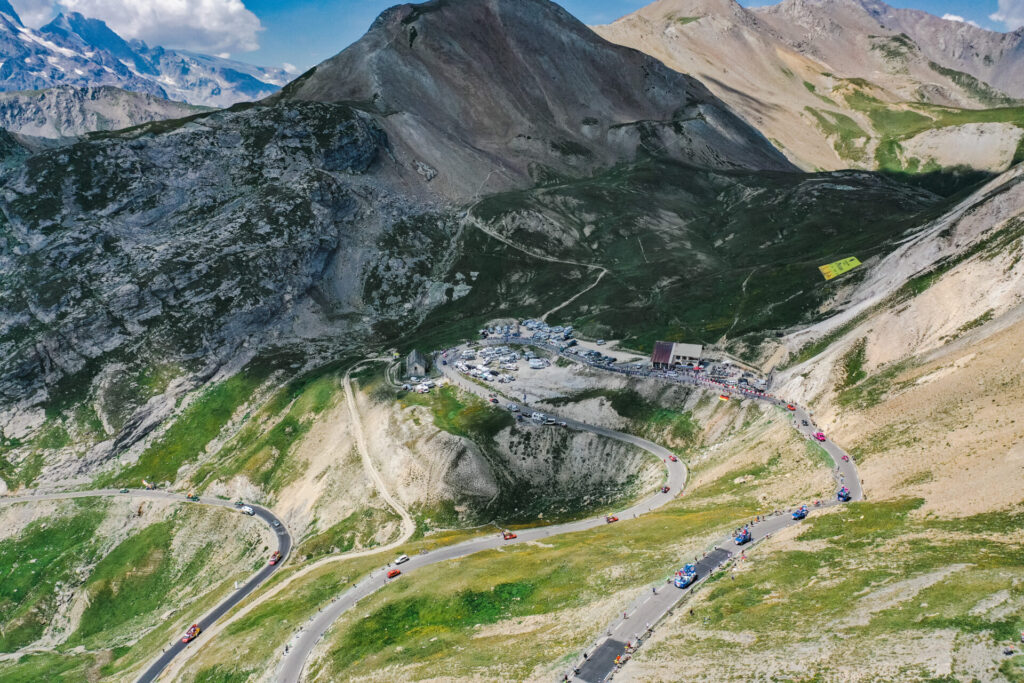
- 21 numbered hairpin bends
- Expected time well-trained touring cyclist: around 1h15-1h25
Double Huez. The peloton finishes here in both stages 19 and 20, which is unique in Tour history. For ordinary souls like us, it is Alpe d'Huez a bucket list climb: the turns are numbered from 21 to 1, and on each turn is the name of a previous stage winner. The pros do the (long stretch) in about 53 minutes, although the Alpe d'Huez record is held by Pantani in under 40 minutes. This is usually a shorter route then. Well-trained touring cyclists are often around 1h20 on the whole route, or under an hour on the short version.
Col de Sarenne
- Distance: 12.9 km
- Average rise: 7.3%
The “wild side” of Alpe d'Huez. Smaller, quieter, bumpier. In stage 20, the peloton rides back down via the Sarenne before climbing Huez again. For touring cyclists who want to avoid the crowds of the 21 turns, this is a practical alternative.
Plateau de Solaison
- Distance: 11.6 km
- Average rise: 8.9% (stretches to 11%)
New to the Tour and immediately tough. This is clearly not a short, casual training ride. Suitable for cyclists comfortable on longer climbs above 8%.
L'Étape du Tour 2026: pro for a day
The L'Étape du Tour 2026 takes place on Sunday 19 July and follows the route of stage 20: Le Bourg-d'Oisans to Alpe d'Huez, via:
- Col de la Croix de Fer (24 km at 5.2%)
- Col du Télégraphe (12 km at 7.1%)
- Col du Galibier (17 km at 6.8%)
- Col de Sarenne + finish on Alpe d'Huez
Total: 170 km with 5,400 altimeters on closed roads, with official feed stations and broom truck. The course is considered tough compared to recent L'Étape editions. Realistic assessment: you should be able to ride comfortably for 6-7 hours in hilly terrain to complete this within the time limit.
Practical: plan your own Tour trip
Accommodation and logistics
- Bourg d'Oisans is home to everything around Alpe d'Huez, Galibier and Sarenne. Book early, as around the Tour period everything is full months in advance.
- Pau Works as a base for the Pyrenees cliffs.
- Bike rentals of high-end carbon race bikes are available in both regions, but popular providers fill up quickly in high season.
Also check out CyclingDestination for a great plan to go with partner Huttopia de Tour to follow in 2026
Road closures during the Tour
Want to ride a col and watch the pros pass afterwards? Roads usually close to all traffic, including cyclists, several hours before the race. Those who still want to climb should get to the top early in the morning or ride a day earlier.
Material
A compact gear (minimum 34×32, preferably 34×34) makes long climbs above 7% a lot more bearable. Wide tyres (28-30 mm) help on the sometimes rough asphalt strips of the Sarenne. And count on disc brakes if you do several descents of 15+ kilometres in a row.
The 2026 Tour de France will start in Barcelona on 4 July. The cols are there all year round, snow permitting. Local authorities publish in spring which mountain passes are open when, depending on snow conditions.